


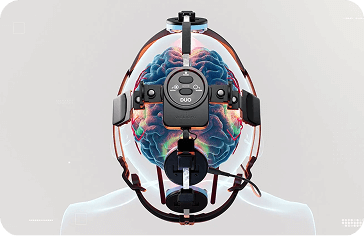





Is 810nm or 1064nm (1070nm) better for brain photobiomodulation?
Across all age groups, the 810nm wavelength has shown to have a deeper and stronger energy disposition than 1064 nm (1070 nm) in a dosimetry study by Harvard Medical School, Department of Psychiatry and several other universities. Even though 1064 nm (1070 nm) scatters less, it is absorbed more by water molecules, which are abundant in human tissue, especially the brain (70-80% water).
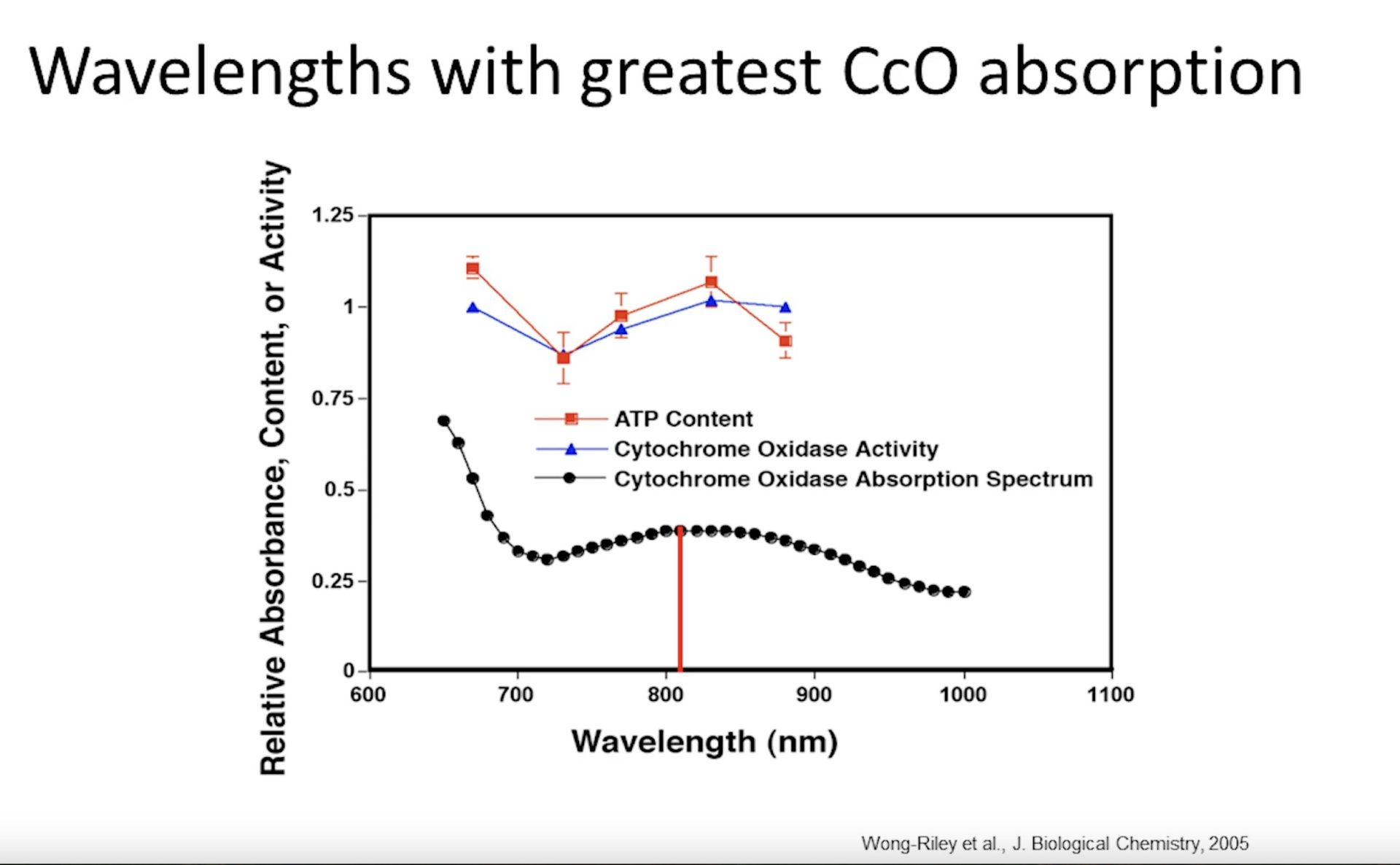
In terms of cellular effects, 810 nm has a stronger effect on mitochondria because photonic absorption by cytochrome c oxidase (CCO) peaks around 810nm and declines as the wavelength gets longer. Direct CCO photoexcitation is weaker at 1064 nm and 1070 nm compared to 810 nm because they are off-peak for mitochondria’s CCO absorption, which peaks around 810 nm.
On the other hand, 1064 nm (1070 nm) has a stronger effect on calcium ion channels, which 810 nm does not have a strong effect on.
The rest of this article, complete with science references, expands more on the differences, covering well-studied biophysics-based biological effects.
Does 810 nm or 1064 nm (1070nm) penetrate deeper into the brain?
According to a transcranial brain photobiomodulation (PBM) study by Harvard Medical School, Department of Psychiatry, the 810nm wavelength has been found to be superior to other wavelengths, which includes higher wavelengths in the 1070nm range for penetration and dosimetry.
According to this study by Harvard Medical School, the order of penetration and dosimetry effectiveness is:
-
810 nm – consistently highest across all age groups and regions
-
850 nm and 1064 nm – next most effective in most cases
-
670 nm and 980 nm – lesser deposition overall
This Harvard study is also supported by another brain PBM dosimetry study by leading Chinese universities, comparing 660 nm, 810 nm, 880 nm and 1064 nm. They discovered that the distribution of photon fluence at 660 and 810 nm within the brain was much wider and deeper than 980 and 1064 nm.
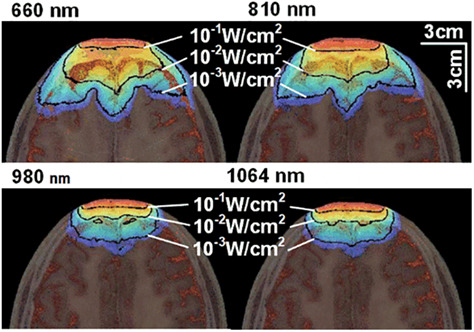
The distribution of photon fluence at 660 nm, 810 nm, 980 nm and 1064 nm. Image source: https://doi.org/10.1002/jbio.201800173
The Role of Water Absorption and the First Optical Window in Brain PBM
The differences in dosimetry are supported by a well-established biological principle, the body’s first optical window. While, the 1064 and 1070nm wavelengths are longer and scatter less, they are more strongly absorbed by water, which is abundant in biological tissues, especially the human. The brain consists of 70-80% water, and floats in cerebrospinal fluid (CSF) while the rest of the human body is approximately 60% water. This makes wavelengths like 1064 nm and 1070 nm particularly susceptible to water absorption within the brain.
While 810nm light is preferentially absorbed by chromophores like cytochrome c oxidase in mitochondria and hemoglobin in the blood, 1070nm light is more significantly absorbed by water, which is the primary chromophore for that specific wavelength.
This increased absorption by water can lead to reduced photonic availability and tissue penetration despite the longer wavelength, which the Harvard Medical study and Peking Medical University study reveal. These studies indicate that 810nm has a higher dosimetry than 1064 nm and by extension, 1070 nm.